
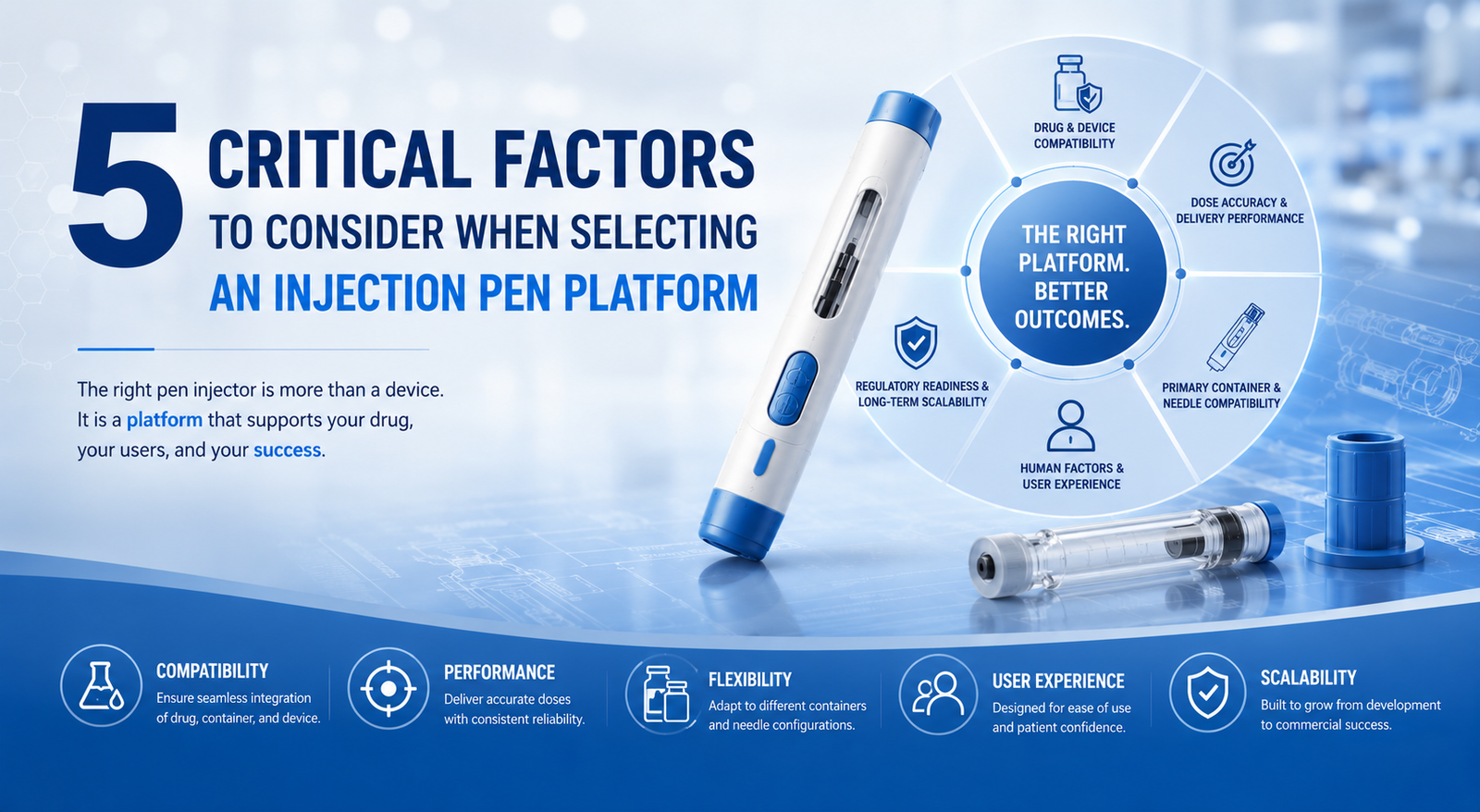
5 Critical Factors to Consider When Selecting an Injection Pen Platform
Selecting an injection pen is not simply a matter of choosing a device that can deliver a specific dose.
For pharmaceutical and biotech companies developing injectable therapies, the right pen injector must work as part of a larger drug-device system — from the primary container and formulation to human factors, regulatory requirements, and long-term commercial production.
A device that performs well during early evaluation may still create significant challenges later if its compatibility, scalability, or regulatory pathway has not been considered from the beginning.
So, what should development teams evaluate before selecting an injection pen platform?
Here are five critical factors to consider.
1. Drug and Device Compatibility
The first question is not simply whether the drug can be delivered through the device.
The real question is whether the drug, primary container, and injection device can function together as an integrated system.
Different formulations can have significantly different requirements for injection delivery.
Important considerations may include:
- Drug viscosity
- Injection volume
- Concentration
- Required dose range
- Delivery time
- Formulation stability
- Required injection force
For example, a highly viscous formulation may require a different drive mechanism or injection force profile than a low-viscosity formulation.
The same principle applies to the primary container.
A pen injector designed around a 1.5 mL cartridge may not be directly suitable for a 3 mL cartridge, even if the basic injection mechanism appears similar.
Therefore, compatibility should be evaluated across three dimensions:
Drug + Container + Device
Physical fit is only the beginning.
2. Dose Accuracy and Delivery Performance
Dose delivery is one of the most important performance characteristics of an injection pen.
The selected platform should provide reliable and repeatable dose delivery across the intended operating range.
Development teams should evaluate factors such as:
- Minimum dose increment
- Maximum dose
- Dose-setting mechanism
- Dose accuracy
- Injection force
- Delivery time
- End-of-dose behavior
- Mechanical tolerances
For multi-dose pen injectors, the relationship between dose increment and cartridge volume is particularly important.
A platform with a 0.01 mL dose increment, for example, provides a different dosing strategy from a platform with a larger increment.
The appropriate configuration depends on the drug concentration and intended therapeutic dose.
This means device selection should be based on the actual dosing requirements of the therapy, rather than selecting a pen first and adapting the drug program around it.
3. Primary Container and Needle Compatibility
The injection device does not operate independently.
It must integrate with the primary container and needle system used in the final drug-delivery configuration.
For pen injectors, development teams may need to consider:
- Cartridge size
- Cartridge material
- Cartridge dimensions
- Closure and sealing configuration
- Pen needle compatibility
- Needle gauge
- Needle length
- Connection mechanism
For example, a 3 mL cartridge-based platform may offer different development opportunities from a 1.5 mL cartridge platform.
Similarly, needle selection can influence injection force, delivery performance, and user experience.
A successful device platform should therefore provide sufficient flexibility to accommodate the intended primary container and needle configuration without creating unnecessary engineering changes later.
4. Human Factors and User Experience
A technically reliable device can still fail to deliver a good user experience.
For self-injection products, the patient may be responsible for performing the entire injection process without professional assistance.
That makes usability an important part of device development.
Considerations may include:
- Ease of dose setting
- Grip and ergonomics
- Activation force
- Audible and tactile feedback
- Dose visibility
- Injection confirmation
- Loading and preparation steps
- Training requirements
Different user populations may also have very different needs.
A device intended for experienced healthcare professionals does not necessarily require the same interaction design as a device intended for patients performing self-injection at home.
Human Factors Engineering should therefore be considered during platform selection rather than being treated as a final validation activity.
Early usability considerations can help prevent expensive redesign later in the development process.
5. Regulatory Readiness and Long-Term Scalability
A device may perform well technically but still be unsuitable for a commercial development program if its regulatory and scalability requirements have not been considered.
Before selecting a platform, development teams should ask:
- What regulatory pathway is expected?
- What verification and validation activities will be required?
- How will human factors requirements affect development?
- Can the platform support future dose configurations?
- Can it accommodate different cartridge specifications?
- Can the design scale from prototypes to commercial production?
- Can the supplier support the required quality and documentation system?
These questions are especially important when the same platform is expected to support multiple products or indications.
A device that works for a single early-stage project may not necessarily be the best platform for a broader product pipeline.
This is where platform thinking becomes increasingly important.
From Device Selection to Platform Selection
The traditional approach is often straightforward:
Find a pen that works → test it → customize it → manufacture it.
However, a more effective approach is to evaluate the complete development ecosystem from the beginning:
Drug → Primary Container → Device → User → Regulatory → Commercialization
Each component influences the others.
A change in formulation can affect injection force.
A change in cartridge configuration can affect the device mechanism.
A change in dose range can affect the dose-setting system.
A change in the target user population can affect Human Factors requirements.
And a late design change can ultimately affect regulatory submissions and commercial timelines.
This is why the cheapest or simplest device at the beginning of a project is not always the most efficient choice over the entire product lifecycle.
What Makes a Strong Injection Pen Platform?
A strong injection pen platform should provide more than basic injection functionality.
It should provide a foundation for future development.
Flexible Device Configurations
Support for different dose ranges, cartridge formats, or injection requirements.
Primary Container Compatibility
Integration with appropriate cartridges and other primary packaging components.
Human-Centered Design
Usability considerations incorporated into the device development process.
Regulatory Support
Development documentation and verification strategies aligned with the intended regulatory pathway.
Commercial Scalability
A development path that can transition from prototype evaluation to larger-scale commercial production.
The goal is not simply to find a device that works today.
The goal is to select a platform that can continue to work as the product evolves.
Final Thoughts
Choosing an injection pen is an early decision with long-term consequences.
A platform that appears suitable during initial evaluation may create unexpected challenges when drug compatibility, dose requirements, usability, regulatory expectations, and commercial scalability are considered together.
The most effective approach is therefore to evaluate the complete drug-device system, rather than judging a device by its mechanism or initial price alone.
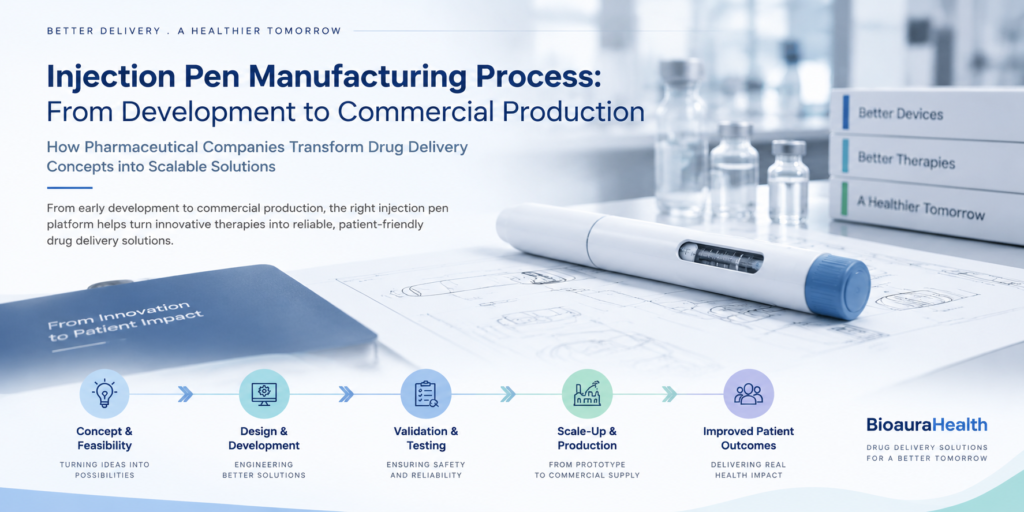
For pharmaceutical and biotech companies, the right injection pen platform should provide a reliable path from early development through validation, regulatory submission, and commercialization.
The best device is not necessarily the one that works first.
It is the platform that continues to work as the product moves forward.


Comment (1)