Reusable vs. Disposable Injection Pens: Which Platform Is Right for Your Drug?
Choosing between reusable and disposable injection pens is an important decision for pharmaceutical and biotechnology companies developing injectable therapies. The selected platform can influence the drug delivery configuration, patient experience, primary container requirements, packaging strategy, and overall product lifecycle costs.
However, neither platform is universally better. The right choice depends on the intended drug formulation, dosing requirements, target users, and commercial strategy.
This guide compares reusable and disposable injection pens and outlines the key factors to evaluate before selecting a platform for your drug development program.
1. What Is a Reusable Injection Pen?
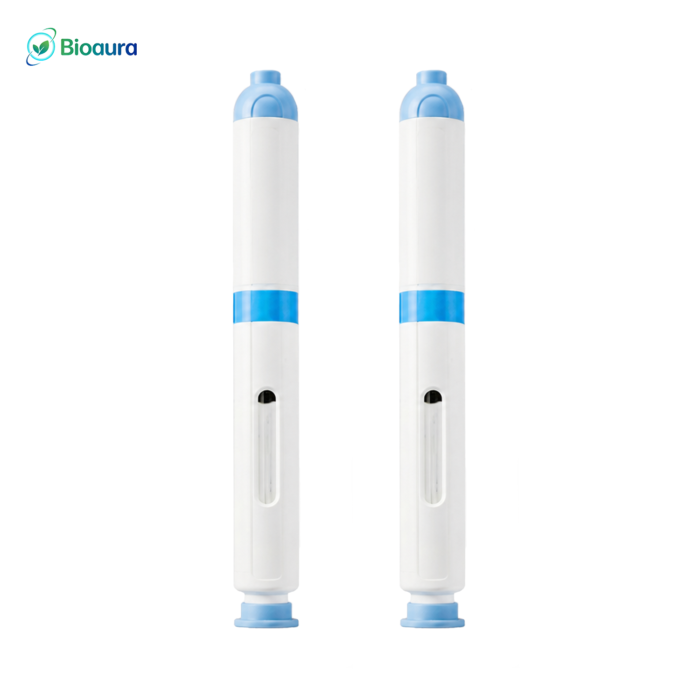
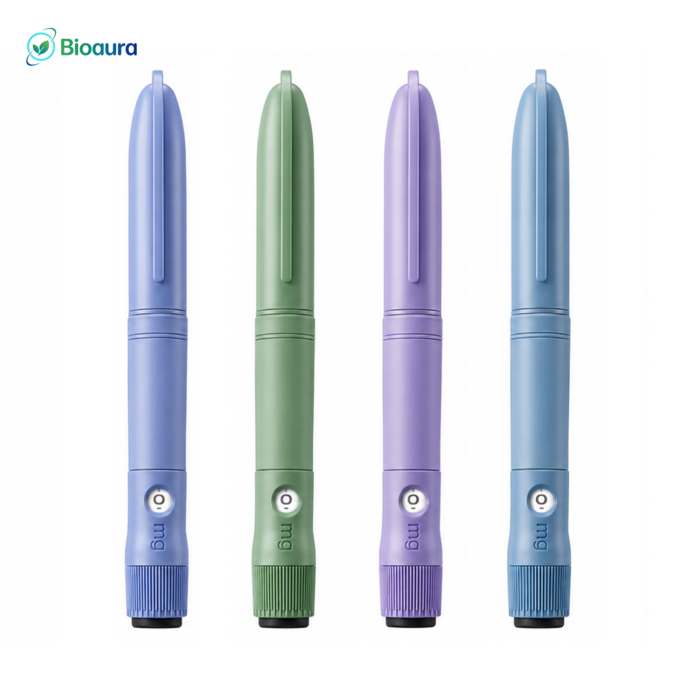
A reusable injection pen is designed for repeated use with replaceable drug cartridges. Depending on the device design, the user replaces the cartridge when the drug supply is exhausted while retaining the reusable pen mechanism.
This configuration separates the reusable device from the drug container, making cartridge compatibility and replacement procedures important considerations during development.
Key characteristics may include:
- Reusable device body: The pen mechanism is retained for multiple uses.
- Replaceable cartridge: The drug container is changed according to the intended use instructions.
- Longer device service life: The pen may be used over an extended period, subject to its design and specified service life.
- Additional user steps: Cartridge replacement and preparation may be required.
Reusable pen injectors may be suitable for products where repeated dosing, cartridge replacement, and long-term device use align with the intended treatment regimen.
For a broader overview of device selection, see our guide to key factors for selecting an injection pen platform .
2. What Is a Disposable Injection Pen?
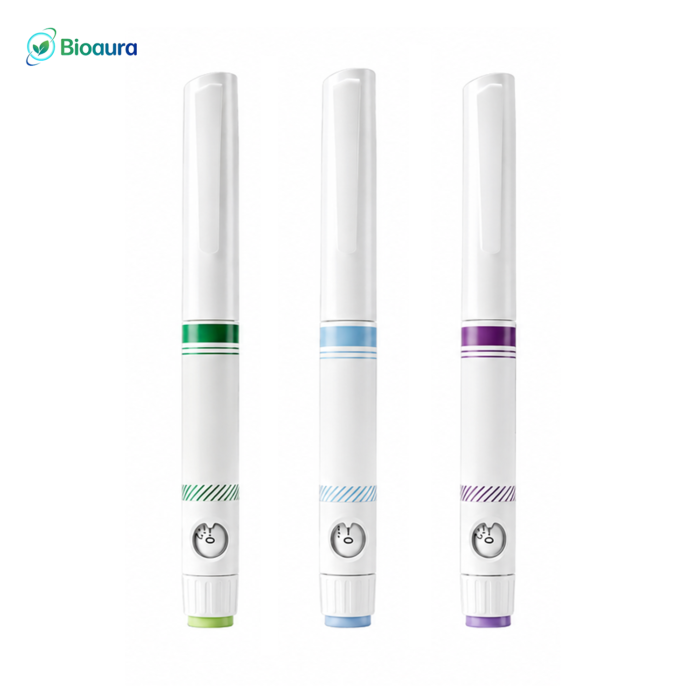
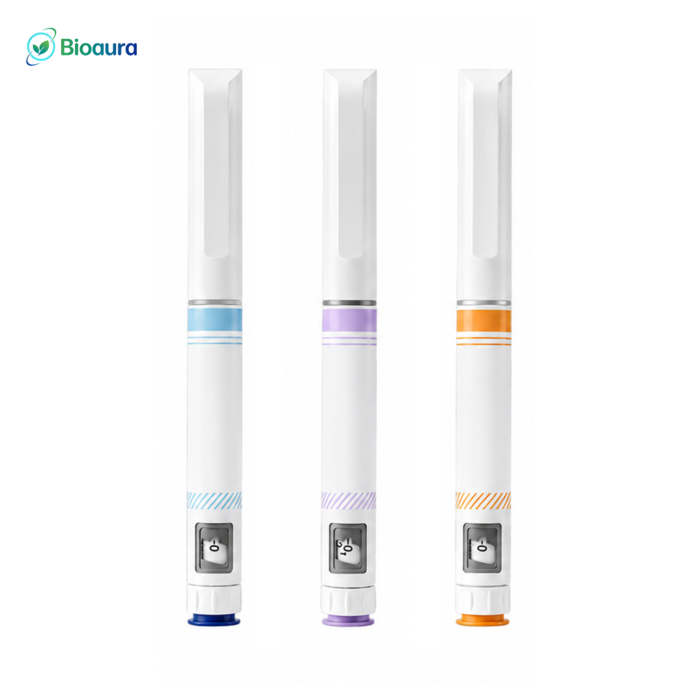
A disposable injection pen is intended to be discarded after its specified use period or drug supply has been exhausted. Many disposable pens use a prefilled drug container, although the exact configuration depends on the product design.
Because the device is not intended for continued use with replacement cartridges, the user generally does not need to retain and reuse the same pen body over successive drug supplies.
Key characteristics may include:
- Single-use device lifecycle: The pen is discarded according to its instructions for use.
- Integrated configuration: Many designs combine the delivery mechanism and prefilled drug container.
- Simplified replacement: Users typically replace the entire pen rather than changing the cartridge.
- Packaging considerations: Each replacement device requires appropriate packaging, distribution, and disposal planning.
Disposable injection pens may be appropriate when a ready-to-use configuration and straightforward device replacement are priorities. The suitability of a specific design still depends on the drug, dose regimen, and intended user population.
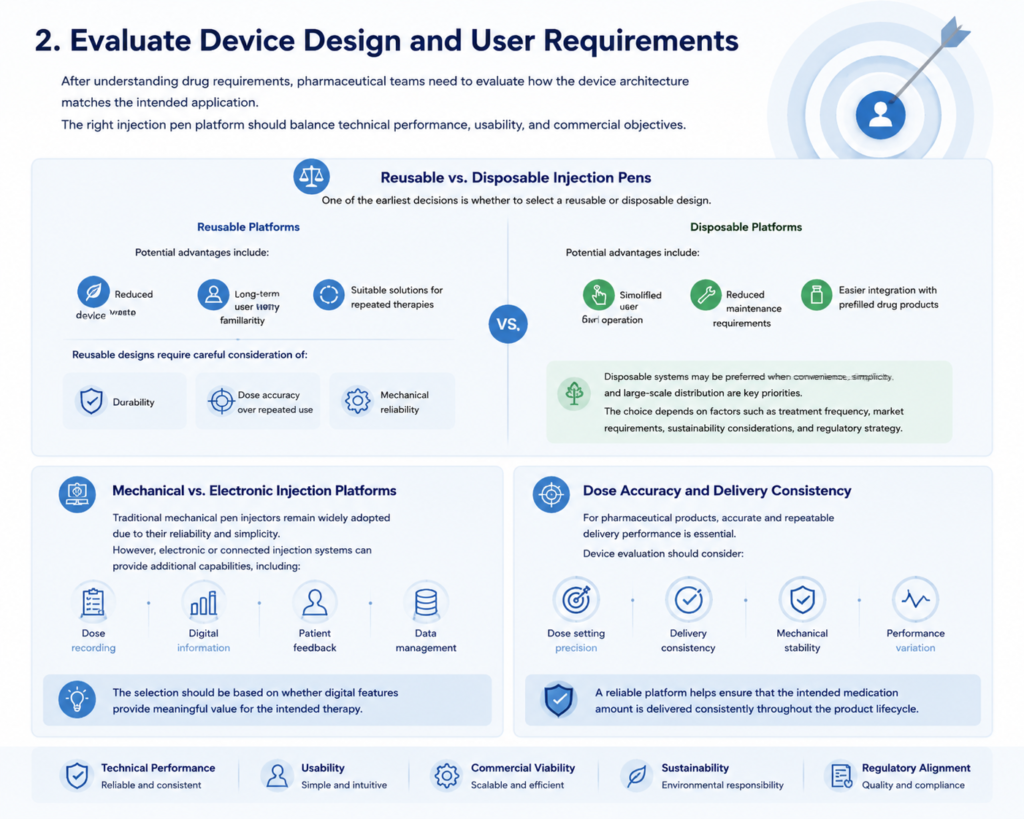
3. Reusable vs. Disposable Injection Pens: Key Differences
The most useful comparison considers the complete drug delivery system rather than the device body alone.
| Evaluation Factor | Reusable Injection Pen | Disposable Injection Pen |
|---|---|---|
| Device lifecycle | Retained and reused according to its specified service life. | Discarded after the intended use period or drug supply is exhausted. |
| Drug container | Typically uses a replaceable cartridge. | Often uses an integrated prefilled container. |
| User operations | May require cartridge replacement and preparation. | May simplify replacement by using a new pen for the next supply. |
| Initial device supply | Requires a reusable device and compatible cartridges. | Requires complete disposable units for the intended supply. |
| Lifecycle cost | Depends on device cost, cartridge supply, service life, and user needs. | Depends on complete device cost, packaging, distribution, and replacement frequency. |
| Waste considerations | The device body may be retained, while used cartridges and other components require appropriate disposal. | The device is discarded according to its instructions, potentially generating more device-related waste. |
| Development priorities | Cartridge compatibility, replacement procedures, and repeated-use performance. | Integrated device configuration, packaging, and single-use performance. |
These are general design tendencies, not universal rules. Actual configurations, operating procedures, costs, and environmental impacts must be assessed for the specific product.
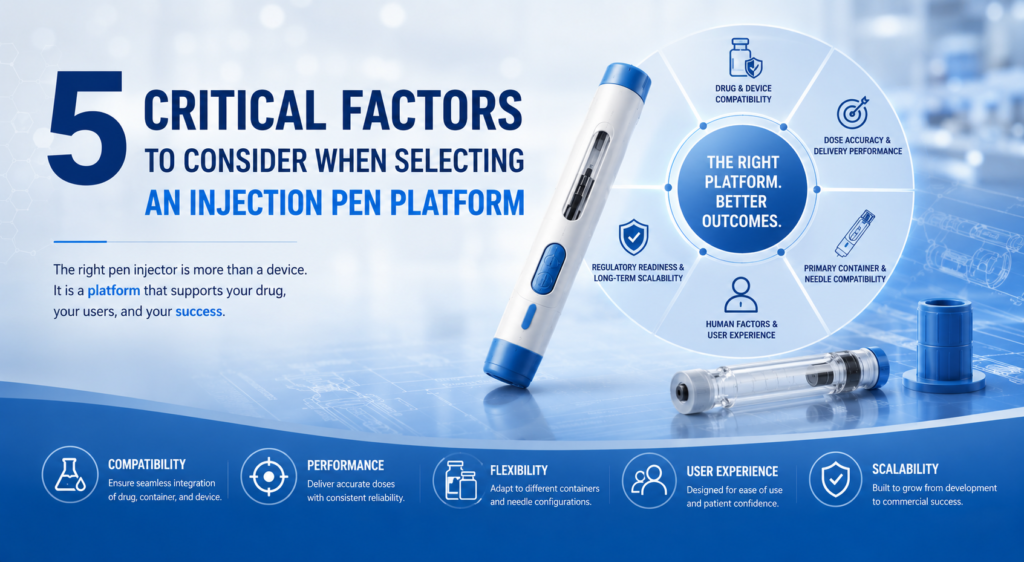
4. Five Factors to Consider When Selecting an Injection Pen Platform
Drug Formulation and Dosing Requirements
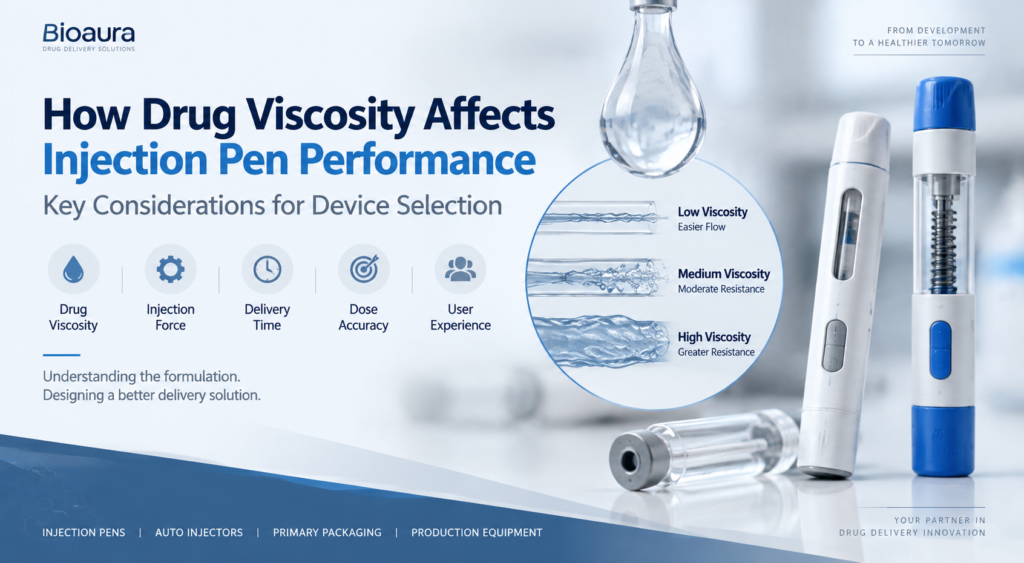
Start with the drug rather than the device. Consider the required dose range, injection volume, formulation characteristics, and dosing frequency. Drug viscosity and injection force may also influence platform suitability.
A device should be evaluated against the intended formulation and delivery requirements, including the relevant operating conditions and dose accuracy expectations.
Primary Container Compatibility
Reusable pen injectors commonly depend on replaceable cartridges, while many disposable designs integrate the drug container into the device. Cartridge dimensions, materials, closure systems, and container compatibility must be evaluated for the intended configuration.
A cartridge that physically fits does not automatically establish functional compatibility. The assembled drug-device system requires appropriate evaluation.
User Experience and Human Factors
Consider who will use the device and how often. Cartridge replacement, dose setting, preparation steps, injection confirmation, and disposal procedures can affect usability.
Human Factors Engineering should be considered early enough to inform platform selection and identify potential use-related risks before the design is finalized.
Regulatory and Verification Requirements
The intended market, drug-device combination, and device design can influence the applicable regulatory pathway and evidence requirements. Development teams should consider risk management, design verification, usability evaluation, and the documentation needed for the intended submission.
These requirements should be assessed for the specific product rather than assumed to be identical for all reusable or disposable platforms.
Lifecycle Cost and Commercial Scalability
The lowest initial device price does not necessarily represent the lowest total cost. Evaluate the complete cost structure, including the device, cartridge or integrated container, packaging, distribution, replacement frequency, and expected product lifecycle.
Also consider whether the supply chain and production arrangements can support the required commercial volumes, quality expectations, and long-term supply continuity.
5. Which Platform Is Right for Your Drug Development Program?
The following framework can help narrow the initial selection:
- Consider a reusable platform when replaceable cartridges, repeated device use, and a suitable long-term user workflow align with the product requirements.
- Consider a disposable platform when an integrated device configuration, straightforward replacement, and a single-use lifecycle align with the intended treatment and user needs.
- Evaluate both platforms when drug requirements, lifecycle costs, patient preferences, or commercial constraints do not clearly favor one option.
The final decision should be supported by an assessment of the complete drug-device system. Dose requirements, container compatibility, usability, verification needs, and commercial supply arrangements should be considered together.
Conclusion
Reusable and disposable injection pens offer different approaches to drug delivery. Reusable platforms retain the device body and typically use replaceable cartridges, while disposable platforms are intended to be discarded after their specified use period or drug supply is exhausted.
The right choice depends on the drug, dosing regimen, primary container, user requirements, and product lifecycle strategy. A platform should not be selected on initial price or physical fit alone.
For pharmaceutical and biotechnology companies, evaluating these factors early can help identify a suitable development path and reduce avoidable changes later in the project.
Looking for an injection pen platform for your drug development program?
BioauraHealth supports drug delivery projects through injection device platforms, primary packaging options, and development-oriented solution coordination. Contact our team to discuss your formulation, dosing requirements, and target application.